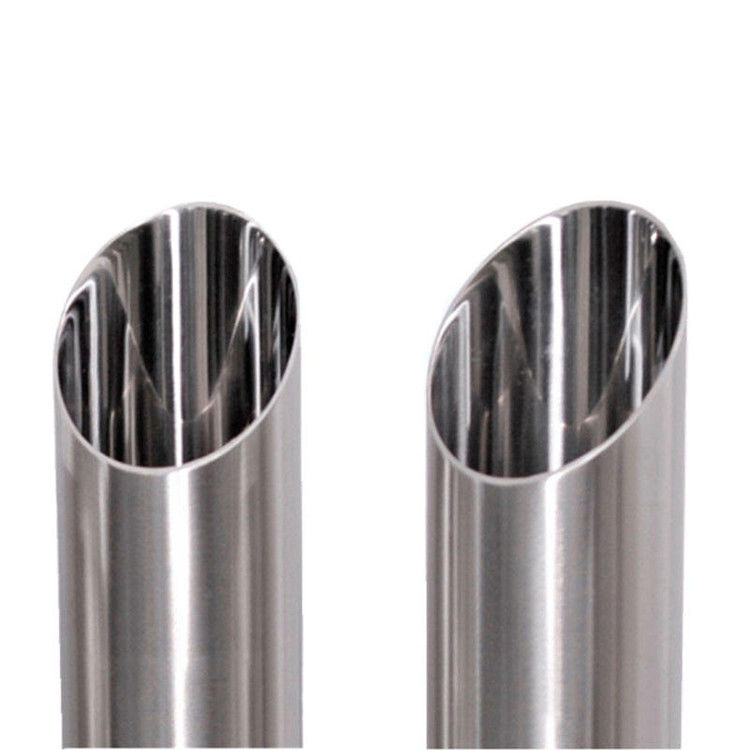
What welded tube is, and what it is not
A welded tube starts as a strip, is formed into a cylinder through a series of rolls, and the two edges are welded together, either by tungsten inert gas, by high frequency induction, or by laser. The weld runs the full length. After welding the tube is sized, straightened and, for the grades sold here, annealed to remove the weld stress and restore the corrosion resistance in the weld zone.
That weld is the whole difference from a seamless tube, and it is why a welded tube is roughly 30 to 40 percent cheaper at the same size. On a handrail, a furniture frame, a conveyor roller or a structural post, the weld is irrelevant. On a line that will be bent to a tight radius, expanded into a tube sheet, or machined on the outside, the weld becomes a defect path and seamless is the correct specification.
The 2 mm wall and why it matters at 1 to 3 inch
At 2 mm wall on a 3 inch tube, the wall to diameter ratio is about 1 to 38. That is stiff enough to hold a span without internal support, which is why this combination is bought for guard rails, racking, mezzanine posts and machine frames rather than for fluid transfer. At 1 inch, a 2 mm wall is heavy for the diameter and is normally specified where the tube will be threaded, since the thread cuts about 1.5 mm deep and needs material to remain.
Wall tolerance on welded tube is normally plus or minus 10 percent. For a threaded or socketed joint the wall at the thread should be checked: a 2 mm nominal wall at the low end of tolerance leaves 0.3 mm under a 1.5 mm thread, which is not enough to take a load.
| Parameter |
Value |
| Grade |
304, 304L, 316L, 201 on request |
| Outside diameter |
1 - 3 inch (25.4 - 76.2 mm) |
| Wall thickness |
0.5 - 2 mm |
| Length |
1 - 6 m, cut to order |
| Weld type |
TIG, annealed in line |
| Surface |
Pickled, polished, brushed, or mill finish |
| Tolerance |
OD +/- 0.15 mm, wall +/- 10 % |
| Standard |
ASTM A554, EN 10296-2, JIS G3446 |
The inside weld bead, which nobody mentions until it matters
Welded tube leaves a bead on the inside of the seam. On a structural or decorative tube it is ignored. On a tube that carries flow, it is a roughness element, a crevice for deposits to collect in, and on a hygienic line a cleaning failure point.
Three levels are available. As welded leaves the bead intact. Bead rolled flattens the internal bead to within about 0.1 mm of the wall during forming, which is the normal specification for fluid tube. Bead removed and annealed gives a smooth bore with a controlled inside diameter, which is what a pneumatic conveying line or a hygienic line needs. The cost rises with each step, and the specification should say which is required rather than leaving it to the mill.
Annealed or unannealed: the corrosion consequence
Welding leaves the seam in a sensitised condition if the carbon content is above 0.03 percent, and it leaves a heat tint oxide that is chromium depleted. Both reduce corrosion resistance exactly at the seam, which is the worst possible place because it is also where residual stress sits.
Tube supplied annealed and pickled has had the tint removed and the chromium restored, and will perform through the seam the same as the parent strip. Unannealed tube can look identical and fail along the weld line within a year in a damp or coastal environment. If the tube is going outdoors, ask for the annealing and pickling to be stated on the certificate, not just the grade.
Fabrication notes
- Bending: a welded tube bends to about 3D radius without a mandrel; below that, use a mandrel and specify annealed tube, or the weld will wrinkle on the inside of the bend.
- Threading: cut threads need a wall of at least 1.5 mm at the thread root. Rolled threads are stronger but need a dedicated machine.
- Welding: 308L filler for 304 to 304. Purge the bore with argon on any hygienic or fluid line, or the root will be scaled and will not clean.
- Cutting: a cold saw or a band saw leaves a square end for a socket joint. An abrasive disc work hardens the cut face.
Packing
Tube is bundled in hexagonal packs, strapped with plastic coated steel band, with end caps on the bore, and shipped on timber cradles. Polished tube is interleaved with paper and wrapped in woven bag; bright annealed tube is wrapped in a protective film because handling marks cannot be polished out without changing the surface.
Frequently asked questions
Is the tube annealed after welding?
Yes, in line annealed as standard, with pickling to remove the heat tint.
Can you supply 316L instead of 304?
Yes, in the same size range at a higher price.
What is the maximum length?
6 m as standard. Longer lengths need to be checked against container and handling limits.
Do you supply polished tube?
Yes, 180 to 600 grit and mirror finish, on request.


 Your message must be between 20-3,000 characters!