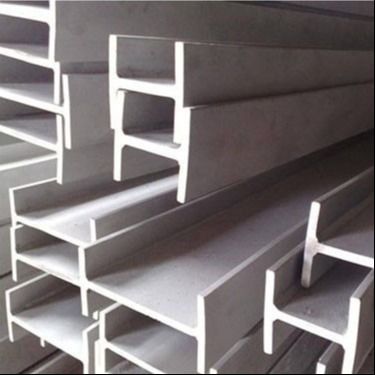
Two ways to make a stainless H beam, and why it matters
There is no rolling mill in the world that rolls an H beam in stainless steel at commercial volume. Austenitic stainless work hardens and needs far more rolling force than carbon steel, and the demand for a rolled stainless H section is too small to justify a dedicated mill pass. So every stainless H beam on the market is made one of two ways.
The first is fabrication: three plates, two flanges and a web, joined by submerged arc or flux cored welding, with the web set square and the flanges held in a jig to control camber and bow. This is how most stainless H beams are produced, and it is the only practical route for a 900 mm deep section. It gives a section with a defined weld, a heat affected zone along four lines, and a dimensional accuracy that depends on the jig and the welder rather than on a mill stand.
The second is hot drawing or extrusion of a smaller section, typically below 200 mm, where a solid billet is pushed through a die. The section is seamless, with no weld, but the size range is limited and the tooling cost is only justified on a long run.
Ask which process is being quoted. A welded beam is normal and perfectly serviceable, but the weld has to be considered in the design, and the price difference between a welded and a drawn section is large.
The grade question, which is where most of these projects go wrong
An H beam is a structural member. It carries load, and the load path depends on the section's stiffness and its yield strength. Stainless steel does not have the same design values as carbon steel, and 201 or 202 has materially lower corrosion resistance and different ductility from 304.
201 and 202 are manganese bearing austenitics, developed as a low nickel alternative. They are strong in the cold worked condition, they are cheap, and they are suitable for dry indoor applications such as retail fitments, exhibition structures and decorative frames. They are not suitable for a wet, coastal or chemical environment, and they are notch sensitive in a way that 304 is not.
430 is ferritic and magnetic. It is used where a magnetic response is wanted, or where cost dominates and the environment is dry. It is less weldable than 304 and the weld zone toughens poorly.
304 and 316L are the grades to specify for anything load bearing in a wet or exposed location. For structural design, EN 1993-1-4 is the stainless eurocode part, and it uses a 0.2 percent proof stress rather than a yield stress, with different buckling curves from carbon steel. A beam designed to EN 1993-1-1 using carbon steel values and then built in 304 will be under designed, because the proof stress of annealed 304 is around 210 MPa against 235 MPa or more for S235, and the stiffness assumption in the connection design also changes.
What the section is used for
Bridge and footbridge elements where a painted steel beam would need maintenance access that does not exist. Water treatment and desalination plant structures, where the beam is inside a wet enclosure. Swimming pool and spa buildings, where chlorinated air attacks carbon steel at roof level. Food and pharmaceutical plants, where the structure is inside the hygienic zone. Architectural and canopy work where the beam is exposed and the client wants no coating.
In most of these the beam is not the governing element. The connections are. A stainless beam bolted to a carbon column needs an isolation pad and stainless fasteners, or the joint becomes the corrosion site and the beam is blamed for it.
Specification
| Parameter |
Value |
| Grade |
201, 202, 304, 304L, 316L, 430 |
| Section |
H and I, web 100 to 900 mm, flange 50 to 300 mm |
| Process |
Welded from plate, or hot drawn below 200 mm |
| Length |
1 to 12 m, cut to drawing |
| Tolerance |
plus or minus 5 percent on dimensions, 2 mm per metre camber |
| Surface |
Pickled and passivated, polished, or hairline |
| Welding |
Submerged arc or flux cored, full penetration on request |
| Test |
MTC 3.1, UT or RT on welds, PMI, dimensional report |
| Packing |
Sea worthy, steel strapped, lifting points marked |
Non standard sections are the normal case rather than the exception. An OEM drawing with a 450 mm web, 180 mm flanges and 8 mm plate is a routine fabrication, not a special order. Send the section drawing with the plate thicknesses and we will quote the fabricated weight, the weld procedure and the lead time.
Fabrication detail worth agreeing before the order
- Weld size and profile. A full penetration weld on a 12 mm web is a different cost from a 6 mm fillet, and the drawing usually does not say.
- Camber. A fabricated beam will bow from weld shrinkage. If the beam is visible or carries a sliding load, specify a camber tolerance and expect a straightening operation.
- Flange to web squareness. On a deep section this governs whether the beam sits flat on a bearing plate.
- Surface treatment after welding. Pickling and passivating the weld zone is not optional on an exposed stainless beam; without it the heat tint is the first place corrosion appears.
Frequently asked questions
Can you supply a single beam?
Yes, one piece upward, though the set up cost dominates the price below about three pieces.
Is a welded H beam as strong as a rolled one?
For static loading, yes, if the weld is full penetration and the design accounts for the heat affected zone. For fatigue loading, the weld toe is the governing detail and must be designed as such.
Can the beam be supplied with holes or end plates?
Yes, CNC drilled and with end plates welded, which is usually cheaper than site drilling.
What is the lead time for an OEM section?
Typically three to five weeks depending on plate availability and weld procedure qualification.


 Your message must be between 20-3,000 characters!