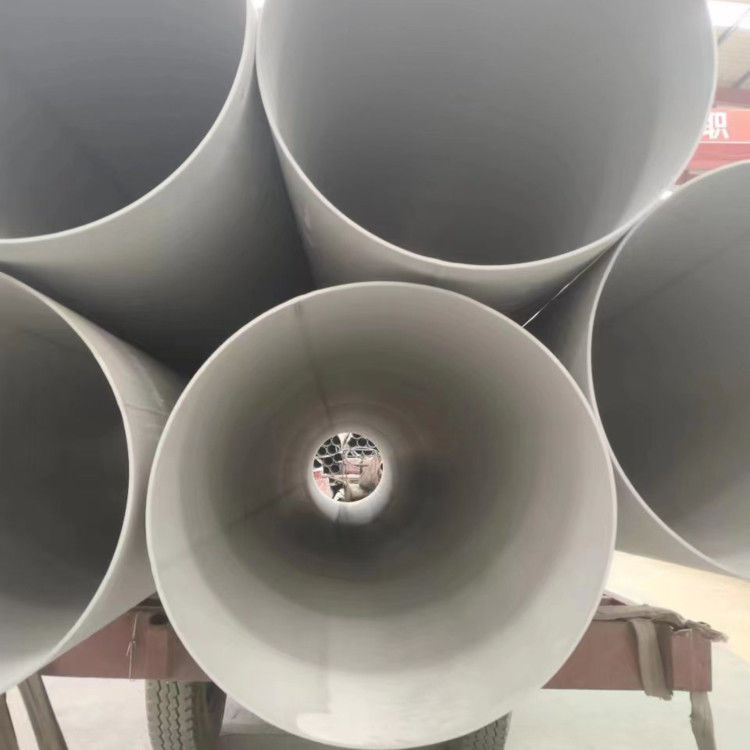
Four finishes, four different failure modes
The finish on a 201 tube is a cost decision and a durability decision at the same time, because 201 has less corrosion margin than 304 and the surface treatment is what stands between the metal and the environment. Choosing by appearance alone is how a project ends up with a rust complaint six months after handover.
- Mirror 8K - buffed to a reflective surface. The polishing removes the outer skin and exposes inclusions, so on 201 it is the most sensitive finish to damp. It looks the best and lasts the shortest time outdoors.
- Hairline (HL) - a directional grain at 320 to 400 grit. It hides fingerprints and light scratches, and it is the normal choice for elevator doors, appliance trim and interior cladding.
- Pickled - the oxide and the chromium depleted layer from welding are removed chemically, leaving a uniform matte grey. This is the finish with the best corrosion performance, because nothing is left on the surface except passive metal.
- Sandblasted - a uniform matte texture produced by abrasive blasting. It reads as a soft grey and takes paint or a clear coat well. The blasting must use a stainless specific media, because blasting with a contaminated abrasive embeds iron and the tube rusts at every impact point.
The 201 problem stated plainly
201 is an austenitic stainless with 16 to 18 percent chromium, 3.5 to 5.5 percent nickel and 5.5 to 7.5 percent manganese. The manganese replaces part of the nickel, which is why 201 costs 20 to 30 percent less than 304. The trade off is a lower pitting resistance and a higher inclusion content.
Those inclusions are manganese sulphides. When you polish or blast a 201 surface you open them, and an open inclusion is a site with no chromium and no passive film. In a dry interior it does not matter. In a bathroom, a kitchen, a car wash or anywhere with condensation and chlorides, those sites are where the first rust spots appear, and they appear along the grain direction of the finish because that is where the abrasive has smeared the metal.
The honest guidance: 201 with mirror or hairline for dry indoor work is fine and saves real money. For wet, coastal or exterior work, either move to 304 or specify a clear anti fingerprint coating over the finish, which closes the surface and is what most elevators and appliance panels actually carry.
Specification
| Parameter |
Value |
| Grade |
201, 304, 316L |
| Outside diameter |
9.5 - 114 mm (3/8 to 4 inch) |
| Wall thickness |
0.4 - 3 mm |
| Length |
1 - 6 m, cut to order |
| Finish |
Mirror 8K, hairline, pickled, sandblasted, satin |
| Weld |
TIG, in line annealed |
| Coating option |
Anti fingerprint clear film, PE or PVC protective film |
| Standard |
ASTM A554, EN 10296-2 |
Cost order and where the money goes
Pickled is the cheapest finish because it is a chemical pass, not a mechanical one. Satin and hairline add one or two polishing passes and a moderate cost. Sandblasting is comparable to hairline but is usually applied to flat or short sections, since blasting a long tube evenly is difficult. Mirror is the most expensive, and the cost is not linear: an 8K mirror on a 6 m tube costs several times the pickled price of the same tube, because the polishing line speed drops with every grit step and the reject rate rises.
A common cost mistake is to specify mirror for a component that will be painted, wrapped or hidden after installation. If the visible surface is 20 percent of the tube, polishing the other 80 percent buys nothing.
Handling and packing by finish
Mirror and hairline tube cannot be repaired on site, so handling damage is the main claim risk. The packing has to match the finish: interleaved with paper or foam, ends capped, wrapped in woven bag, and loaded so no coated surface rests on another. Pickled tube is far more forgiving and is normally bundled with only end protection.
If the tube is to be cut or drilled on site, the cut end will show an untreated edge on a pickled tube and a bright edge on a polished one. Either way, plan for the cut to be hidden or for the fitting to cover it.
Frequently asked questions
Will 201 mirror tube rust indoors?
In a dry, heated interior it will not. In a humid bathroom or an unheated warehouse it can spot, especially along the grain.
Can you apply anti fingerprint coating?
Yes, on mirror and hairline finishes, as a clear nano coating. It reduces marking and closes the surface.
Is sandblasting available on 6 m lengths?
Yes, but the uniformity is better on shorter lengths. Samples should be approved before a production run.
What media is used for blasting?
Aluminium oxide or glass bead, dedicated to stainless. Iron bearing media contaminates the surface and causes rust spots.


 Your message must be between 20-3,000 characters!