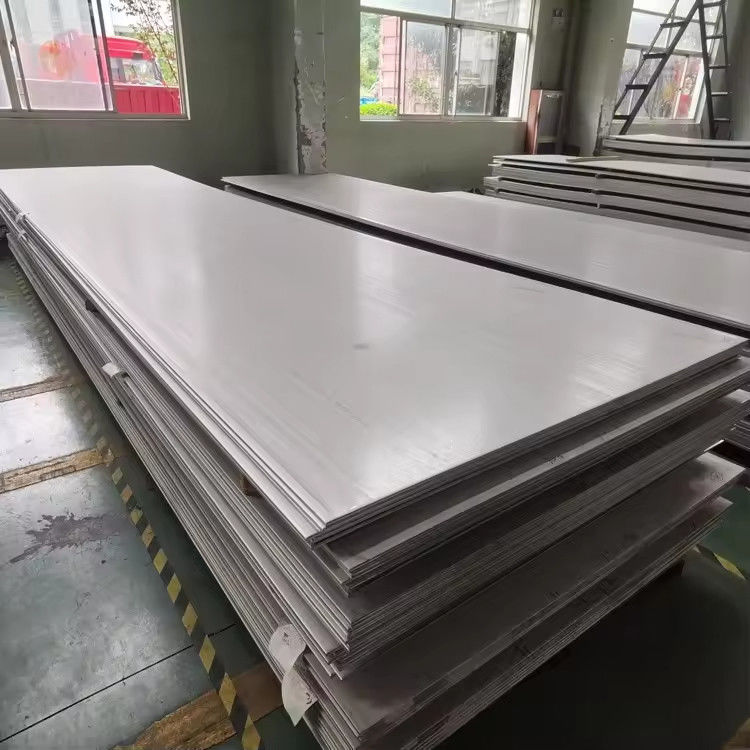
Why 0.3 mm is a different product from 1 mm sheet
Below roughly 0.5 mm, stainless sheet stops behaving like plate and starts behaving like foil. A 0.3 mm sheet in 304 has enough stiffness to hold a flat panel across a 500 mm span, but it dents under a knuckle and it oil cans between supports if the flatness is not controlled at the rolling stage. Buyers who take 0.3 mm from a general sheet supplier and treat it like 1 mm usually come back with a flatness complaint.
This item is produced to a thickness tolerance of plus or minus 0.02 mm, measured at three points across the width, with a flatness limit of 3 mm per running metre. It is slit from cold rolled coil, tension levelled, then cut to length. The tension levelling step is what separates a sheet that lies flat on a table from one that rocks.
Which grade to use at thin gauge
304 is the default. It forms well, welds without fuss and takes a brushed or mirror finish evenly. At 0.3 mm it is used for appliance skins, kitchen cabinet doors, lift trim, signage faces and electrical enclosure covers.
316L is chosen when the part sees chlorides: coastal signage, marine instrument panels, food processing guards that are washed down daily. The molybdenum addition costs 12 to 18 percent more than 304 and is wasted on indoor dry applications.
410 is a martensitic 12 percent chromium grade. It is magnetic, hardenable by heat treatment, and considerably cheaper than 304 because it carries almost no nickel. At 0.3 mm it is used for cutlery blanks, blade stock, wear plates, heat exchanger fins and decorative trim where corrosion demand is mild. It does not tolerate humid storage: 410 sheet will spot rust in an unheated warehouse within weeks, so it must be kept dry and film protected.
Brushed and polished finishes on thin sheet
Brushing at 0.3 mm is done with a controlled abrasive belt pressure, because too much pressure ripples the sheet. The grain we supply runs along the length at 120 to 180 mesh, giving a uniform silver surface that reads as satin rather than mirror. On request the same base sheet can be supplied in 2B, BA, No.4 or 8K.
Every polished or brushed sheet leaves with a PVC film on the finished face. On 0.3 mm the film also serves a structural purpose during handling: unprotected thin sheet creases at the corner as soon as it is lifted by one edge. Keep the film on until the panel is fixed in place, then peel at a shallow angle.
Specification
| Parameter |
Value |
| Grades |
304, 304L, 316L, 410, 430 |
| Thickness |
0.3 - 1.5 mm (0.3, 0.4, 0.5, 0.6, 0.8, 1.0 stocked) |
| Thickness tolerance |
+/- 0.02 mm |
| Width |
1000, 1219, 1250, 1500 mm |
| Length |
1000 - 6000 mm, cut to order |
| Finish |
Brushed, 2B, BA, No.4, 8K |
| Edge |
Slit edge, burr free |
| Protection |
PVC film, 50 micron |
| Standard |
ASTM A240, EN 10088-2, JIS G4305 |
Fabrication notes for thin sheet
- Laser cutting at 0.3 mm needs low power and high speed; a standard 1 mm recipe will leave dross on the underside.
- TIG welding thin sheet pulls distortion into the panel. Stitch welding or laser welding with a copper backing keeps it flat.
- Hemming the edge by 3 to 5 mm doubles the stiffness and removes the sharp edge, which is why appliance doors are hemmed rather than trimmed.
- Do not clamp thin polished sheet directly in a vice; use soft jaws or the film will be marked through to the surface.
Packing
Thin sheets are packed in bundles of 50 to 100 pieces, interleaved with paper, edge protected with plastic angle and strapped on a plywood pallet. Because the weight per bundle is low, a 20 ft container is normally limited by volume: around 15 to 18 tonnes of 0.3 mm sheet fits before the box is full.
Frequently asked questions
Can you supply 0.3 mm in 1500 mm width?
Yes, subject to coil availability. 1500 mm wide 0.3 mm is produced to order with a lead time of about 20 days.
Is 410 suitable for outdoor use?
Only in dry, mild atmospheres. For exterior exposure we recommend 304 as the minimum and 316L within 5 km of the coast.
Do you cut small quantities?
Yes. One sheet is enough for a sample, and cut to size panels can be supplied against a cutting list.
What is the difference between brushed and No.4?
Brushed (HL) is a fine continuous grain; No.4 is a shorter, coarser grain with a slightly duller look. Both hide scratches, No.4 hides them better.


 Your message must be between 20-3,000 characters!