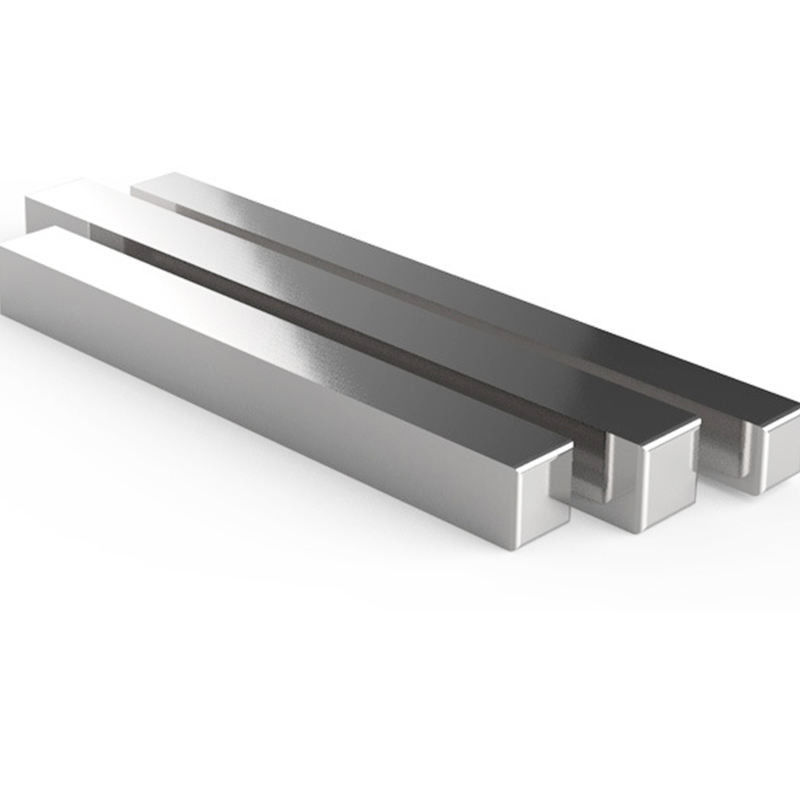
Where 17 mm comes from
Seventeen millimetres is an odd number to find in a metric catalogue, and that is the first thing to check on an enquiry. It is usually one of three things. It can be a converted imperial size: 11/16 inch is 17.46 mm, and a worn or re ground part often measures close to 17 mm. It can be a bar that is machined down from 18 or 20 mm stock. Or it can be a genuine 17 mm drawing dimension, which is common in European food machinery where the bar forms a guide rail, a wedge, a scraper holder or a paddle shaft.
All three are supplied here, but the tolerance requirement is different in each case. A converted imperial part usually needs the bar to clean up at 17.46 mm, so 18 mm stock is the correct starting point. A genuine 17 mm part needs the bar to be 17 mm within its stated tolerance and straight enough to slide in a guide. Tell us which it is, because the answer changes the size we cut from.
Tolerance, straightness and what the drawing should say
Cold drawn square bar is normally supplied to h9 or h11. On a 17 mm bar, h9 allows nothing above 17.000 mm and 0.043 mm below; h11 allows 0.110 mm below. For a guide rail running in a machined slot, h9 is the sensible call. For a frame member that is welded or bolted, h11 is enough and costs less.
Straightness is the specification that is most often left off and most often complained about. Cold drawn bar in 3 or 6 m lengths is typically straight to 1 mm per metre. A 3 m bar can therefore bow 3 mm end to end, which is invisible in a bundle and very visible once it is installed as a guide. If the bar is to run through a linear bearing or slide in a slot, ask for 0.5 mm per metre and expect to pay a straightening charge.
Corner radius is the third item. Drawn square bar has a rounded corner, normally 0.3 to 0.6 mm at this size. A mating part machined with a sharp internal corner will not seat. Put the radius on the drawing rather than discovering it at assembly.
Food contact: what actually matters
Grade 304 is accepted for food contact in most jurisdictions, and 316L is used where the product is acidic, salty or chloride bearing. The grade is only half the question. The other half is surface and geometry, and that is where most food plant failures originate.
A pickled surface has an Ra around 2 to 3 micrometres and a grey, slightly rough appearance. A bright drawn or polished surface is 0.4 to 0.8 micrometres and is easier to clean. For a bar that forms part of a product contact surface, the polished finish is worth specifying, not because bacteria prefer smooth steel in the abstract, but because a rough surface holds residue that a clean in place cycle will not remove.
Geometry matters more than roughness. Two square bars bolted face to face create a crevice, and a crevice is where cleaning fails. Where a bar has to be fixed to a frame, use a continuous weld that is ground flush and passivated, or a standoff that leaves a cleanable gap of at least 20 mm. A bolted joint with a visible gap is a design defect in a washdown area regardless of the steel grade.
Specification
| Parameter |
Value |
| Grade |
304, 304L, 316L on request |
| Size |
17 x 17 mm, 3 to 100 mm other sizes |
| Tolerance |
h9, h11, or K12 for free machining stock |
| Process |
Cold drawn, peeled, or peeled and polished |
| Surface |
Bright, pickled, polished Ra 0.8 or better |
| Straightness |
1 mm per metre standard, 0.5 mm per metre on request |
| Length |
3 m or 6 m, cut to size |
| Standard |
ASTM A276, A479, EN 10278 |
| Test |
EN 10204 3.1 MTC, PMI, roughness report |
Bar for the chemical industry is normally 316L rather than 304, because the process stream rather than the cleaning chemical is the aggressive medium. If the bar is a wet part in a tank or a mixer, specify 316L and ask for the intergranular corrosion test if the part will be welded.
Working with square bar in a plant fabrication shop
Cut it with a band saw or a cold saw, not an abrasive chop saw. An abrasive cut puts enough heat into a 17 mm section to leave a blue heat tint that has to be removed, and on 304 the tint is a corrosion site. A cold saw leaves a square, burr free end that can be welded without further dressing.
Drilling needs a cobalt bit, low speed and steady pressure. Stainless work hardens under a rubbing tool, so a light feed on a hard surface makes the next pass harder. Once the surface is hardened, the hole has to be annealed or the position moved.
Welding 304 square bar to itself or to sheet is straightforward with 308L filler, but the corner geometry concentrates heat. Use a small weave, keep the interpass temperature down, and pickle the joint afterwards. On a food contact part, the weld must be ground flush and passivated, and the grinding must be done with a dedicated stainless disc.
Frequently asked questions
Is 17 mm a stock size?
Not in every mill programme. It is drawn to order, and the minimum is usually one bundle or one length depending on the mill.
Can you supply 17 mm in 316L?
Yes, cold drawn to the same tolerance, with a longer lead time than 304.
Do you provide material certificates?
Yes, EN 10204 3.1 as standard, with PMI and roughness reports on request.
Can the bar be supplied cut and drilled?
Yes. Send the drawing and we will quote the machined part rather than the bar.


 Your message must be between 20-3,000 characters!