DIN standard needs a number
DIN and its replacement EN have at least three standards that a stainless flat product can be supplied to, and they are not interchangeable. EN 10088-2 covers general purpose flat products. EN 10028-7 covers pressure vessels. EN 10095 covers heat resisting steels. The chemistry is broadly the same; the mechanical properties, the testing and the permitted tolerances are not.
A coil described only as "DIN standard 316L" cannot be inspected against anything. For a tank or a vessel shell, the correct call is EN 10028-7 with the impact test and the 3.1 or 3.2 certificate; for general fabrication it is EN 10088-2. Getting this wrong is not a paperwork problem, it is a rejected inspection at the fabricator.
1.4404, 1.4432 and 1.4435 are not the same 316L
All three are called 316L in conversation and they are different alloys.
1.4404 is the standard grade: 2.0 to 2.5 per cent molybdenum, 10 to 13 per cent nickel. 1.4432 raises molybdenum to 2.5 to 3.0 and nickel slightly, which improves pitting resistance and is worth the step in chloride or in a mixed acid. 1.4435 restricts the composition to keep the ferrite content low, for pharmaceutical and food equipment where a minimum ferrite is a hygiene requirement rather than a corrosion one.
The price steps are roughly five per cent from 1.4404 to 1.4432 and ten to fifteen per cent to 1.4435. If the drawing says 1.4435 and you ship 1.4404, the molybdenum number on the certificate will be inside the 1.4404 range and outside the 1.4435 one, and the inspection will catch it.
Specification
| Parameter |
Value |
| Grade |
316L (1.4404), 1.4432, 1.4435, 316Ti |
| Thickness |
3.0 to 12 mm |
| Width |
1000 to 2000 mm, mill edge or slit to width |
| Finish |
No.1, hot rolled annealed and pickled |
| Coil ID |
508 or 610 mm |
| Coil weight |
5 to 20 tonnes |
| Yield strength |
170 N/mm2 minimum (1.4404) |
| Tensile strength |
485 to 700 N/mm2 |
| Standard |
EN 10028-7, EN 10088-2, ASTM A240 |
| Test |
EN 10204 3.1 or 3.2, impact test, PMI |
No.1 finish, and what pickling does not fix
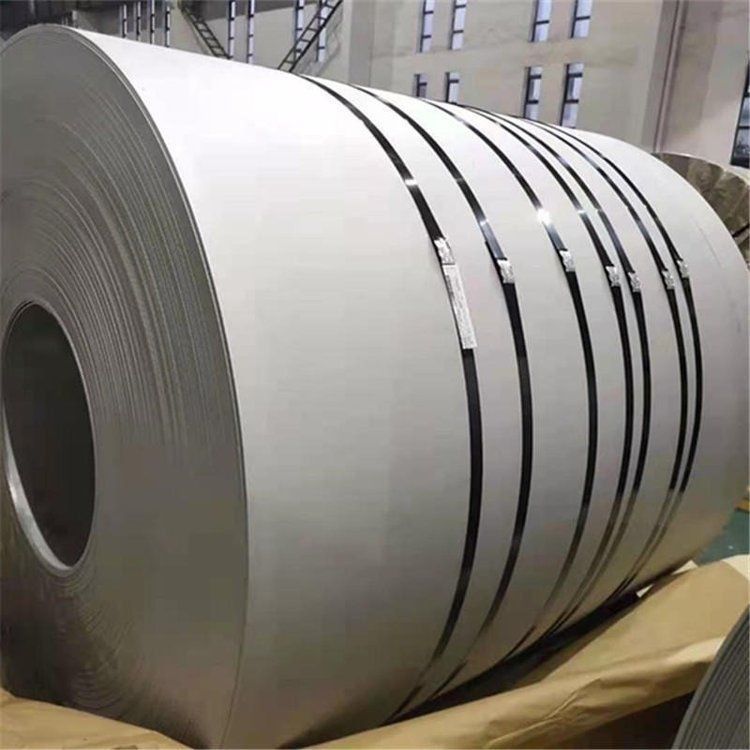
No.1 is hot rolled, heat treated and pickled, with no cold work. The surface is grey and matte, with a roughness that follows the roll and a visible scale pattern after pickling. It is normal to grind or paint it, and it is not a decorative finish.
Pickling removes the oxide. It does not remove a rolled-in sliver, a seam, a scratch from the run-out table, or a lamination. Those are mill defects that survive the acid, and they are found by visual inspection, by PMI and, for pressure work, by ultrasonic test. A pickled coil that looks uniform can still carry a seam that opens when the shell is rolled.
Thickness, width and weight at this gauge
At 3 to 12 mm, hot rolled tolerance is effectively one-sided. Mills roll to the minus side, so a 6 mm coil commonly arrives at 5.75 to 5.85 mm and the buyer pays for six. That is within ASTM A480 and it is not a defect, but if your design needs the full gauge, specify a positive tolerance and expect to pay for it.
Crown is the other number: the centre of the strip is thicker than the edges by roughly 0.5 to 1 per cent of gauge, because the work rolls deflect. On a wide coil slit into narrow strips, the centre strip is heavier than the edge strips, which matters if the parts are weighed.
Weight: a 12 mm by 2000 mm coil is a heavy object, and a 20 tonne coil needs a 20 tonne crane and a saddle, not a forklift. Check the handling before ordering the coil weight.
Where 316L hot coil is the right buy
Tank and vessel shells, heat exchanger bodies, food plant, marine structures, chemical storage, and any part where the surface will be ground or coated anyway. If the part needs a decorative finish, the economics change: buy cold rolled and avoid the grinding.
Frequently asked questions
Can you supply to EN 10028-7 with impact testing at minus 196 C?
Yes, with 3.2 witness testing, on a stated lead time.
Is 1.4432 available in 8 mm?
Yes, but as a mill order rather than from stock.
Do you supply slit width from a hot rolled coil?
Yes, from 100 mm upward, with a slit edge.
What is the difference between No.1 and 2D?
No.1 is hot rolled and pickled; 2D is cold rolled and pickled. 2D is thinner, flatter and more expensive.


 Your message must be between 20-3,000 characters!