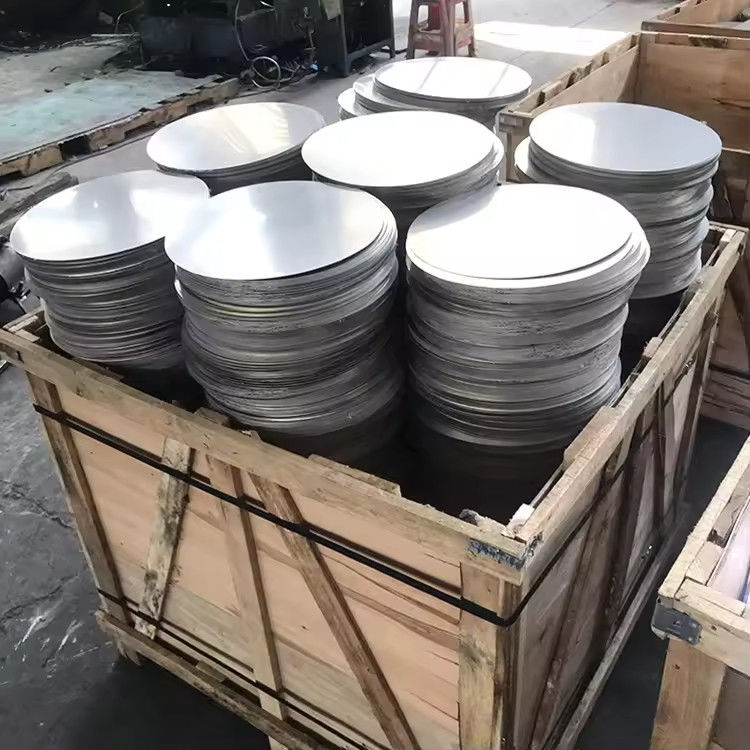
Why cookware uses 410 and 430, and where 201 fits
A pot is not made from one material for one reason. The cooking surface has to resist food acids and detergents, the body has to draw into shape without cracking, and the base has to work on the hob the customer owns. Those three requirements pull towards different grades, which is why a single pan can contain two or three of them.
430 is the 17 percent chromium ferritic, and its commercial advantage is that it is magnetic. On an induction hob the base must be ferromagnetic or the hob will not detect the pan and will not deliver power. That single fact drives most of the material choice in cookware today, and it is why 430 appears on almost every induction compatible pan specification.
410 is 12 percent chromium martensitic, harder and more wear resistant, and also magnetic. It is used where the surface has to resist scratching and abrasion: knife blades, utensil heads, the base plate of a pan that will be moved around a commercial kitchen. It is less corrosion resistant than 430, so it is normally not the food contact surface.
201 is the manganese bearing austenitic, non magnetic, and the cheapest way to get a bright, formable body. It is used for pan bodies, lids, steamer inserts and kitchen equipment housings where the part never goes near an induction hob. It will not work on induction, and no amount of base cladding fixes a 201 body unless a magnetic disc is added underneath.
Induction changed the specification, not just the base
Before induction, a pan base was chosen for heat spreading: an aluminium disc, or a three layer clad with aluminium in the middle. Induction added a requirement that the outer face be magnetic, so a 430 or 410 plate was bonded to the base, or the whole body was made magnetic by using a ferritic grade.
This is worth knowing when a customer asks for a 304 pan that works on induction. The answer is either a clad base with a magnetic outer layer, or a magnetic disc welded or brazed to the bottom. Selling a plain 304 pan as induction compatible is a return waiting to happen.
Deep drawing quality is a metallurgical property, not a grade
A disc that draws into a 200 mm deep pot without splitting is not simply a soft disc. Three things control it: the grain size, the carbon and nitrogen content, and the amount of cold work left in the sheet.
Grain size is specified by ASTM grain size number, and for deep drawing the useful range is roughly 6 to 8. Too coarse and the surface shows an orange peel texture after drawing; too fine and the sheet is strong but cracks at the draw radius.
Earing is the other visible defect: the drawn cup develops a wavy top edge because the sheet has a preferred crystal orientation from rolling. A disc cut from a coil with strong directionality will produce ears at 0, 90, 180 and 270 degrees, and the customer will have to trim more off the top. The fix is a correctly annealed sheet and, where the draw is severe, a disc orientation chosen against the rolling direction.
Specification
| Parameter |
Value |
| Grade |
201, 304, 410, 430, 316L on request |
| Thickness |
0.5 to 4.0 mm |
| Diameter |
100 to 800 mm |
| Diameter tolerance |
plus or minus 0.2 mm sheared, 0.1 mm laser cut |
| Thickness tolerance |
per ASTM A480, or plus or minus 0.02 mm precision |
| Finish |
2B, BA, No.4, or polished one side |
| Condition |
Annealed for deep drawing, or as rolled |
| Flatness |
3 mm per metre, 1 mm after levelling |
| Standard |
ASTM A240, A480, EN 10088-2 |
| Test |
MTC 3.1, hardness, grain size on request |
How the circle is cut, and what it does to the edge
Circle shear is the cheapest method and the standard for cookware. The sheet is rotated against a fixed blade and the circle is cut in one continuous pass. The edge is clean and square, with a small burr on one face, and the diameter is consistent to about 0.2 mm. For a part that will be drawn, this is all that is needed.
Laser gives a diameter tolerance of 0.1 mm and a square edge with a narrow heat affected zone, and it is the choice for a visible rim or a part that will be welded at the edge. The cut edge on a laser has a slight oxide line that must be removed before welding.
Plasma is used above about 6 mm and leaves a rougher, nitrided edge that has to be machined back. It is not a cookware process at these thicknesses.
A burr on a stacked disc is more than a handling issue. During drawing, a burr on the blank edge becomes a stress concentration and the part splits from the edge inwards. Deburring before drawing, or specifying the burr on the non drawing face, is cheap insurance.
Finish, and how it changes the price
2B is the standard cold rolled finish, grey and matte, and it is what most drawn parts start from because the draw operation removes or marks the original surface anyway.
BA is bright annealed, reflective, and used when the inside of the pan will be visible after forming. It costs more per tonne and it shows every scratch and fingerprint, so handling discipline has to be better.
No.4 and polished finishes are applied to the finished part, not usually to the blank, because the forming operation destroys the finish. If a customer asks for a polished disc, ask whether the polish is for the visible inside of the finished pan or for the blank itself, because the answer changes which process is quoted.
Frequently asked questions
Which grade works on induction?
430, 410, or any ferritic or martensitic grade. 201, 304 and 316 are not magnetic and will not be detected by an induction hob.
Can you supply discs for a 250 mm draw?
Yes, with the sheet annealed to a grain size that suits the draw. Send the draw ratio and we will propose the condition.
What is the minimum order?
One tonne, which is roughly 200 discs at 300 mm in 1 mm.
Do you supply polished one side only?
Yes, with the polished face protected by a PVC film.


 Your message must be between 20-3,000 characters!