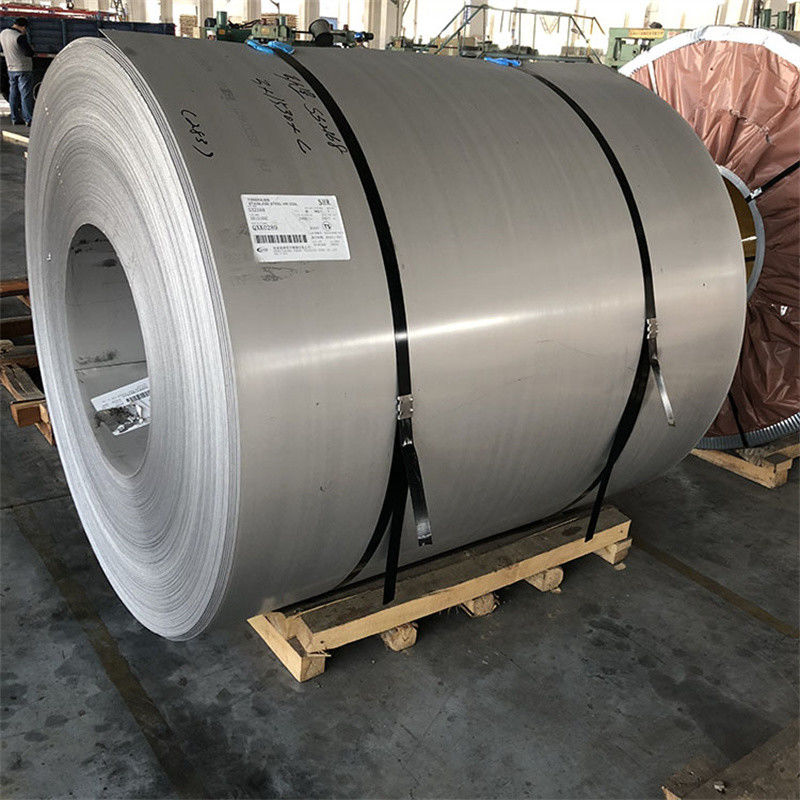
A hot rolled coil cannot have a 2B finish
This is worth stating plainly because the mistake is common in trading listings. 2B requires cold rolling to final gauge, then bright annealing and a skin pass. A hot rolled pickled coil is No.1 by definition. When a coil is offered as "2B hot rolled pickled", one of the two words is wrong: either the material was cold rolled, in which case it is not hot rolled, or the finish is No.1 or 2D and the 2B label is decorative.
The practical test is the thickness and the process route. Hot rolled pickled 430 is supplied from about 3 mm upward. If someone offers 2B 430 at 1.5 mm, it is a cold rolled product. Ask for the process route and the Ra, and the description resolves itself.
What 430 does well, and the two temperatures that ruin it
430 is 16 to 18 per cent chromium, no nickel, ferritic and magnetic. Its advantages are real: no nickel means the price does not follow the nickel market, oxidation resistance holds to about 815 degrees C in intermittent service, thermal expansion is low at around 10.4 micrometre per metre per kelvin, and it resists nitric acid and most food acids.
Two limits cause most of the failures. The first is 475 degree embrittlement: holding 430 between roughly 400 and 500 degrees C for hours makes it brittle at room temperature, and a part that was ductile on delivery will crack on impact after a season in service. The second is grain growth. Above about 900 degrees C the ferrite grains coarsen and do not refine on cooling, so the heat affected zone of a weld becomes coarse and weak.
Specification
| Parameter |
Value |
| Grade |
430, 430Ti, 409L, 410S |
| Thickness |
3.0 to 10 mm |
| Width |
1000 to 1500 mm, slit to order |
| Finish |
No.1 pickled, 2D, or ground |
| Coil ID |
508 or 610 mm |
| Coil weight |
3 to 15 tonnes |
| Yield strength |
205 N/mm2 minimum |
| Tensile strength |
450 N/mm2 minimum |
| Hardness |
up to 88 HRB |
| Standard |
ASTM A240, EN 10088-2 (1.4016) |
| Test |
EN 10204 3.1, mechanical, chemical |
No.1 and 2D on a ferritic
No.1 is the pickled hot rolled surface, grey and matte, with the scale pattern removed by acid. 2D is the same pickling applied to a cold rolled coil, so it is only available at cold rolled gauges. On a ferritic grade a skin pass improves flatness and removes the yield point elongation, which is what causes stretcher strains, but it does not turn a No.1 surface into a 2B one.
If the part will be enamel coated, note that 430 is one of the few stainless grades that takes vitreous enamel, and the surface preparation for enamelling is a separate process from pickling. If it will be painted, a No.1 surface needs a mechanical preparation first, because paint adhesion on a pickled surface is poor.
Weldability, the honest version
430 can be welded, and it is welded every day in appliance and burner parts. The issue is the heat affected zone. Grain growth reduces toughness, and the weld thermal cycle can leave the zone partly martensitic if the cooling is fast, which makes it hard and crack sensitive. Practical guidance: keep the heat input low, use a matching or austenitic filler rather than an autogenous pass on thicker sections, and post-weld anneal at 780 to 850 degrees C followed by a rapid cool if the joint has to bend or take impact. Do not weld 430 into a thick section and expect it to behave like 304.
Where 430 hot coil is bought
Appliance cavities and backs, burner and heater housings, automotive exhaust hangers and heat shields where 409 is too thin, chimney liners, and any part where a magnet is acceptable and the environment is dry and hot rather than wet. It is not a sink grade in a chloride environment and it is not a coastal grade.
Frequently asked questions
Is 430 magnetic?
Yes, strongly, at all temperatures. That matters for electromagnetic stirring and for induction heating.
Can you supply 430 at 2 mm?
Yes, but as cold rolled 2B or 2D, not as hot rolled.
What is the difference between 430 and 430Ti?
430Ti is stabilised with titanium, which suppresses sensitisation and improves weldability at a small cost premium.
Does 430 rust outdoors?
It resists atmospheric staining better than 409 and worse than 304, and it will rust in coastal air.


 Your message must be between 20-3,000 characters!